-
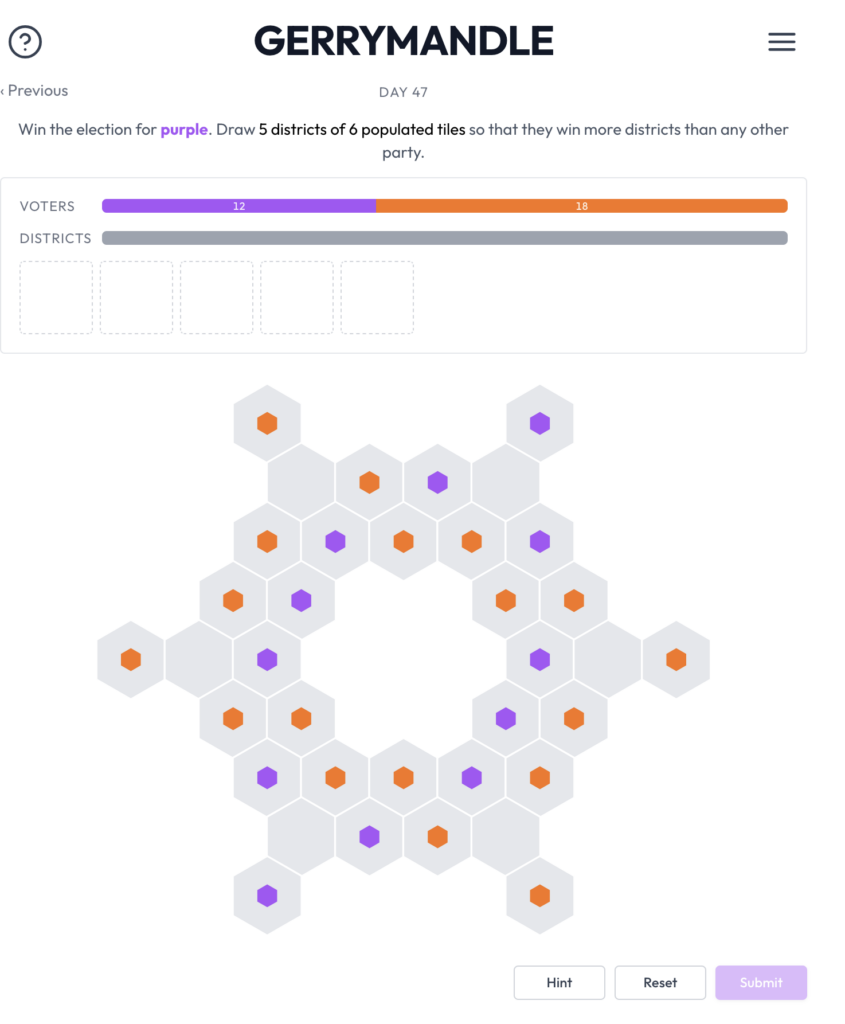
Gerrymandle
A game that shows how gerrymandering is a conscious choice, Gerrymandle.
-
Apocalypse warning system
A novel system tracking private jets as an indicator of impending doom. If the jets are all flying to specific locations, then something’s up. Still not 100% foolproof but still interesting.
In the event of an imminent nuclear apocalypse, we suspect that many people who have access to private jets will immediately take to the skies and escape city centers. This site tracks this indicator in realtime. The current emergency level is reported on a scale of 1 to 5, with 5 being an indicator of a likely imminent apocalypse.
-
How to fight back against AI
Anil Dash has some thoughts regarding how to fight back against big AI companies. Here’s one of them:
One aspect of strategy that’s been largely lost in the tech industry in recent years is how to compete against platforms, since the major tech companies have gotten so big that markets are no longer competitive. However, the AI market is still early enough, and users and society are still angry enough, that the Big AI companies can lose.
But for them to lose, everybody else in the ecosystem has to carry out the nearly-lost art of platform strategy. Tech companies (and even open source communities!) used to carry out these tactics in emerging product categories ranging from desktop office suites to operating systems to web browsers, though over the decades, the lesson that big tech learned was, basically, that they should play dirty.
You win platform strategy battles through power and persuasion. We’re going to get both.
Historically, we would have relied on regulators or media to help hold bad actors in the tech space accountable, but in the United States, these entities are largely not going to help very much. Some state and local governments may assist, and some independent journalists or smaller media outlets are pushing for accountability, but the most powerful entities are either captured or complicit in many cases, so we don’t have the institutional pushback that had sometimes been present in earlier points of technological change.
The thing that matters right now is that we understand that all of the Big AI companies are extremely vulnerable. The reason they’re making so much noise, and spending so much money, is because they know that they’re vulnerable. Users, and especially users who are developers have an enormous amount of leverage to control where AI goes. And if those communities of users can coordinate, they can put power back into the hands of the people. Today, that means focusing on some technical interventions, along with the cultural and political pushback that’s happening. That’s how we begin to reduce, or even prevent, some of the worst AI harms in the future.
Here are some of the proven tactics that have helped shift the balance of power in prior tech reckonings:
1. Get in front of it
The first and most important technical goal is for everyone to push for all AI usage to be disintermediated — where users access their AI apps or services through open tools or interfaces that aren’t controlled by the Big AI companies. These tools, in the form of “harnesses”, or through text editors or command lines, or just through the familiar chat interfaces that lots of people use, need to move as quickly as possible to being controlled by community-built, open options. The sooner this step happens, the sooner we unlock the ability to shift decision-making power out of the hands of the corporate platforms, and begin to undermine their ability to cement lock-in of users.
Status: Good. There are a number of popular, mature tools in almost every category for users who want to access today’s AI tools through a free, open interface. Most of the work now is to get the word out about these tools, and to continue to polish and improve the user experience so that they offer features and design touches that the commercial tools can’t or won’t.
2. Spread the love around
Another key capability that the open ecosystem must provide is the ability to seamlessly switch between different AI providers on the fly, to reduce costs, to provide better performance, or to get both benefits. In many cases, this will be seamless and automatic, just making the right choice for users so that they get the best option all of the time, but advanced users will want to tweak their settings, like when businesses may want to be very aggressive in minimizing the amount of money that their employees are allowed to spend on AI services.
The important part here is that this forces AI platforms that want to compete to remain compatible with all of their competitors, keeping the market dynamic, and ensuring that all of the big providers are easily replaced with another vendor at any time. Basically, we always have to be able to keep them in their place, and they should know that they could go away at any time. Most companies are aware of these needs, but the more regular consumers are familiar with these kinds of requirements, the more pressure there will be on companies to conform with standards. (This is also what will enable the disintermediation mentioned in point 1.)
Status: Good. This is happening already in business environments, where companies demand this kind of flexibility. Developers have been creating very dynamic systems for switching between AI providers, and the ecosystem encourages this kind of switching by extensively comparing different AI platforms against each other whenever new models are released. The important thing to maintain here is the narrative that none of the individual models matter more than the overall ecosystem — and that even the biggest companies have to conform to the same strict formats and standards as the independent AI systems created by communities around the world.
3. Free the tools
Another vital concern for shifting power away from the Big AI companies is undermining them economically. Instead of simply following the classic “commoditize the complement” strategy that commercial companies often execute, open source projects created by a community can more straightforwardly pursue a path of enlightened value destruction. Non-commercial LLMs have been roughly keeping pace with the Big AI platforms, following the pattern I described as “frontier minus six”, where free and open models lag about 6 months behind the most cutting-edge AI labs — which means they’re still pretty freaking great for most uses.
-
Super Mario Crocs
It’s a thing–Super Mario Crocs. Power up your fashion.